¶ Dream Consistency
Internal documentation hub for Dream Consistency products, platform architecture, infrastructure, security, secrets management, deployment standards, shared services, and operational decisions.
¶ Overview
Dream Consistency Hub is the central internal documentation space for product architecture, shared platform contracts, infrastructure decisions, operational procedures, deployment flows, and technical standards.
¶ Products
Dream Consistency products each have their own documentation area with product context, architecture, services, deployment model, operational commands, and change history.

¶ Platform Architecture
Dream Consistency standardizes shared platform contracts and operational processes while preserving physical database isolation between products and environments.
¶ Platform Tools & Operations
Versioned console utilities support controlled environment provisioning, shared system catalog installation, Realm initialization, and other infrequent platform operations.
¶ Infrastructure
| Area | Current Direction |
|---|---|
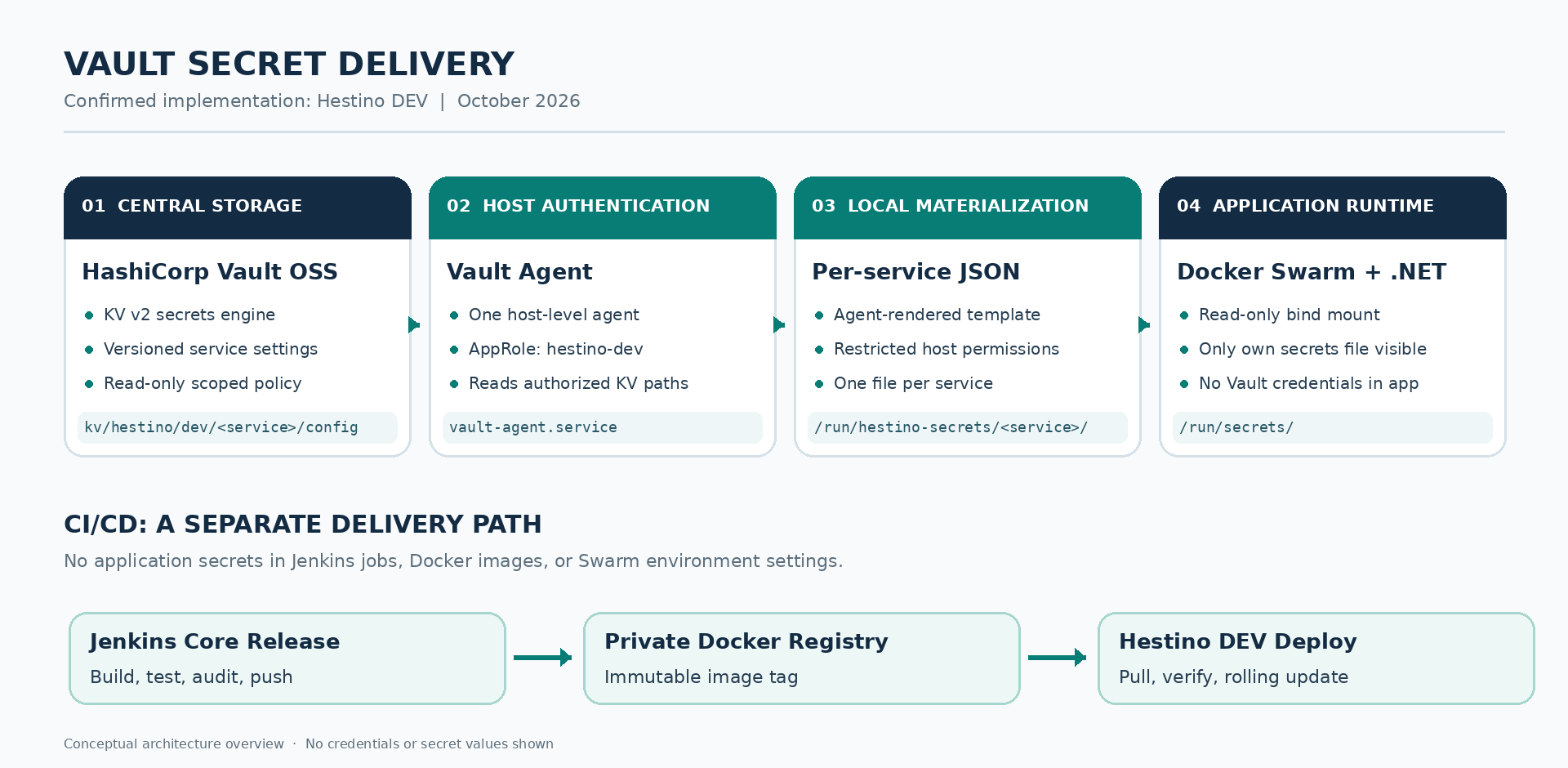
| CI/CD | Jenkins on the Dream Consistency Hub server. Hestino DEV uses separate immutable Core image release and environment-specific deployment pipelines. |
| Docker Registry | registry.dreamconsistency.com for private Docker images. |
| NuGet | nuget.dreamconsistency.com using BaGetter for internal .NET package hosting. |
| Documentation | Wiki.js used as the central internal documentation platform. |
| File Collaboration | Nextcloud for internal file storage and collaboration where needed. |
| Container Orchestration | Docker Swarm; Hestino DEV services consume per-service secrets through read-only host mounts. |
| Secrets Management | HashiCorp Vault OSS with KV v2. In Hestino DEV, a host-level Vault Agent uses AppRole to render restricted, per-service JSON configuration files. |
| Runtime Configuration | Secrets come from Vault-rendered JSON; non-sensitive environment overrides remain in Docker environment settings, with application defaults in appsettings.json. |
¶ Secrets Management & Vault
HashiCorp Vault is the central authority for sensitive runtime configuration. In the Hestino DEV implementation, a host-level Vault Agent authenticates through AppRole, reads narrowly authorized KV v2 paths, and renders a dedicated JSON file for each service. Docker Swarm mounts that file read-only, and .NET services consume it through their configuration providers without receiving Vault credentials.
¶ Shared Libraries & Packages
Dream Consistency shared libraries are internal NuGet packages used across backend services, console tools, and product control planes. They provide reusable infrastructure and shared data contracts for Legislator, Hestino, and future Dream Consistency products.
| Area | Current Direction |
|---|---|
| Internal NuGet Feed | https://nuget.dreamconsistency.com/v3/index.json |
| Package Hosting | BaGetter on the Dream Consistency Hub server. |
| Release Jobs | Manual Jenkins release jobs under DreamConsistency - Packages. |
| Versioning | Semantic Versioning: MAJOR.MINOR.PATCH. |
| Publishing Credential | BaGetter API key stored in Jenkins as dreamconsistency-nuget-api-key. |
| Catalog Libraries | .NET Standard 2.1 libraries with embedded versioned JSON content: Realm, Management, Billing, and future shared catalog contracts. |
¶ Deployment Principles
Product and platform deployments must be versioned, repeatable, reviewable, and documented. Application code and system catalog JSON must not be copied directly to production servers. Build artifacts are created once and promoted consistently across environments.
¶ Documentation Standards
Product, platform, infrastructure, and operational pages should follow a consistent format so that decisions, ownership, risks, and commands are easy to find.
¶ Ownership
| Area | Owner |
|---|---|
| Company | Dream Consistency |
| Product Ownership | Branko / Dream Consistency |
| Platform Architecture | Dream Consistency |
| Infrastructure | Dream Consistency |
| Documentation | Dream Consistency |
| Operations | Dream Consistency |
| Shared Libraries | Dream Consistency |
| System Catalogs | Dream Consistency |
¶ Change Log
| Date | Change | Author |
|---|---|---|
| 2026-10-26 | Added Vault and Secrets Management navigation, Hestino DEV runtime secret architecture, Jenkins and Docker Swarm separation, and security documentation standards. | Dream Consistency |
| 2026-09-09 | Added Realm Identity & Access architecture documentation covering Realm-scoped customer accounts, tenant memberships, and authentication boundaries. | Branko |
| 2026-06-24 | Initial Dream Consistency home page created. | Branko |
| 2026-07-04 | Added internal shared libraries and NuGet package release information. | Branko |
| 2026-08-01 | Added platform data contracts, system catalog architecture, and environment provisioning documentation. | Branko |
| 2026-08-03 | Added Platform Tools navigation and detailed operational documentation for the System Catalog Installer and Realm Bootstrap utilities. | Branko |